



Get started
Get in touch to learn more about how a TMS can help you
Training Management Systems make ILT easy.
John Peebles meets with Char Noland of CloudShare to show where ILT and VILT costs hide and how automation and virtual labs cut them.
Instructor-led training is still the majority of corporate training, and the most expensive part of it isn’t what most people expect. In this Training Magazine webinar, John Peebles, CEO of Administrate, and Char Noland, VP Global Solutions Consulting at CloudShare, break down where the cost of ILT and VILT sits and how to bring it down without cutting the hands-on experience learners value most.
They walk through the hidden costs for training programs at scale: hours of planning and scheduling per class, spreadsheets and calendars that only one person understands, and the build, provisioning, reset and teardown of every hands-on lab environment.
The session includes a case study of Ping Identity, a joint customer of Administrate and CloudShare. By linking CloudShare lab blueprints to Administrate course templates, the Ping team can handle 3x the demand while maintaining the same training team size. The discussion closes with practical ways to lower ILT costs and a Q&A.
1:01:18 watch · 10,488-word transcript
Auto-generated transcript — may contain errors. Tap a timestamp to jump the video.
Welcome, everybody. This is Gary Van Antwerp from Training Magazine Network. I am delighted to welcome you here today because you got a very important topic that comes up all the time, especially when the economy goes sideways or even even worse. Lowering the cost of instructor led training is is a topic that's always on the minds of every training leader. And if it's not, it should be because it's on the minds of your COO. So we're gonna talk today about how to do that. And here to walk us through that is John Peebles. John is the CEO of Administrate. And then Char Noland from CloudShare is here. She is the VP of solution consulting. We're gonna turn things over to them shortly. I do have a little bit of information I wanna share with you first. I'm Gary.
I'm your producer today. You can send me a private chat or note using the chat, and I'll be happy to help you if you need that. We have a lot of webinars coming up. I've been booking webinars all the way into August 2027. But coming right up in the next couple of days, we have, tomorrow. It's not a typo. We have two, webinars back to back as we often do. Dave Vance is gonna be here, and he's gonna talk about three steps to greater impact in running your L&D business like a business. Okay? So for many of you who are here today, that's going to be an important topic, And I hope you can join us for that. And, of course, we'll be recording it if you can. And then also later in the day, folks from Adobe are going to be here, and they're gonna be talking about agentic AI. Alright? It's not gonna be about Adobe Captivate today.
It's gonna be about agentic AI and and how there's a new baseline for learner expectations. We've got a great group of speakers. Doctor Alan Partridge is here, Justin Sealy, Alister Lee, and. So come and join us tomorrow. That's going to be at noon Pacific. Okay? So Dave Vance at 9AM Pacific and the Captivate team at noon Pacific. Now I mentioned earlier that if you'd like a transcript, we'll have one for you. We're making it right now. And if you look at the recording a little bit later on, when you launch the recording, when you hit play, then the transcript automatically pops up on the right hand side of the of the frame. If you look right up here, there's a little download icon. So you can download the the transcript of everything that's being said today by John and Charlene.
And then right here, you can see there's a tab there. See that? There's a black thing. That's a tab. Well, in a moment, you're gonna see that instead of that one, now that we're joined by another one, and that means there are handouts. So those of you who are watching the recording right now, you can download the handouts for today's session by just clicking on that tab. For those of you in the live session, you have a handouts pod right down here. And sometimes we call it resources, but there it is. You can download the handout. It's the very top one on that list. Okay? We encourage you to look at some of the others, but don't miss that one. Before we get started, we wanna thank Administrate today for sponsoring this session, for making it possible for John Peebles and Charlene to be here. Administrate can help you automate live training operations that you can't afford to get wrong.
Right? And joining us today too in in helping us present this and putting a lot of time and energy into creating this this presentation and, more importantly, the thoughts behind it. Charlene is here from CloudShare, and we wanna thank CloudShare for being a partner in this webinar as well. So thanks to both Administrate and CloudShare. I'll give you some links later on to enable you to to visit them and learn more about what you can do. But right now, let's go ahead and get started with lowering the cost of instructional, pardon me, instructor led training. And I'm gonna hand things off at first to John Peebles, the CEO of Administrate. John, welcome back to Training Magazine Network. Glad to have you here. Alright. Thank you very much. And, yeah, delighted to join everybody.
It's always fun to hear where everybody is dialing in from around the world. I am currently dialing in from Edinburgh, Scotland, which is where I live and where we are headquartered. But we have teams... Teammates all across the world. And, we'll just do some, quick introductions here. My name is John, as, Gary said. Gonna talk to you a lot about not only how you can manage classroom training or ILT and VILT, but do so at a much cheaper, way and method and so forth. And I'll let Char, introduce yourself. We're just gonna have a a pretty informal chat, and we'd love questions coming in from the chat while we're while we're talking. So, Char, why don't you say hi? Sure. Hi, everyone. I'm Char Noland. I'm with CloudShare. And while I've been with software and in the software industry for the greater part of twenty years, before that, I was a trainer.
So I was in a lot of your shoes training folks, using everything from good old transparencies on overheads to today supporting the... You know, some of the largest training environments in the world. So I'm excited to be here. Thank you for having me. Alright. And just real quickly, I'll give an overview of what Administrate is. We are a platform that helps large enterprises. A lot of times, they're multinationals, not always. Large companies that are doing a lot of ILT and VILT at scale, handle all the scheduling, all the planning, all the issue detection, and the resolution of when things go wrong. And in addition to helping manage those kind of classroom ILT, VILT operations, We have a lot of fantastic partners like CloudShare who do very specific, very important, very high value things to help that ILT and v I...
VILT get facilitated. So maybe, Char, you give us a quick overview of CloudShare, what problem you guys solve. Sure. John, we help provide virtual environments, virtual training environments, which translated to plain English means we give everybody that hands on experience. So I think everybody on this call recognizes that hands on experience is probably the most effective way to train folks if you want them to retain and remember. And we make setting up those environments very easy because that's not always easy to do. Yeah. One of the things that I love about CloudShare is it solves... You guys solve a problem that I had about twenty five years ago. That's when I was in college as a teacher's assistant. And I was getting a computer science degree, and one of my favorite jobs actually that I ever had was being a TA.
And I would go into these computer labs and help. And the reason I liked it is because, you know, I could solve problems, and I enjoy that. But, also, it's just such a great way to help me learn and deepen my understanding. You know, when you're teaching something, it's one of the best ways to learn. Anyway, we we would have loved to have a product like CloudShare because, you know, these physical machines were always dying, and you'd walk in, and there'd be three out of commission and all this stuff. And CloudShare just automates all that provisioning, and you can do it remotely and all of this stuff. So it's a product that I wish I'd had a long time ago, and I'm glad that our customers have today. It's true. I I used to carry a a computer through a a little Sun server called the through airports to do my training classes, and I'm I'm not sure I get through security these days with that box.
They might want to know what else I was up to. Yeah. Absolutely. So we got a loose agenda here. We got a bunch slides because we get carried away when we're talking about something that we're passionate about. But, you know, we're gonna kinda make our way through these four or five topics, which is, you know, why sometimes it just takes a trainer, you know, why you just cannot divorce this idea of classroom instruction from really critical concepts. Talk a little bit about how to scale ILT and VILT because that's really top of mind for the folks that we talk to. We've got a case study, which is a joint customer of ours and has been a joint customer for ours for over a decade. A really fantastic success story there. And then talk a little bit about how you think about your budget. And lastly, we've got a guide that can hopefully bring all this together because I know it could be a lot to digest.
So we got a question before we dive in. So how many in the chat are with us today or managing complex ILT and VILT today? So we'll give you, you know, 30, sixty seconds to to answer that. And, Char, you're you're relatively new with CloudShare, but, you know, one of the things that's pretty cool is CloudShare and Administrate have been partners for probably over ten years now. And one of the things that we really like about CloudShare as a partner is they've got a culture of building a product and helping their customers, but they also have a culture of helping out their partners. And I remember very clearly about ten years ago, the CloudShare founder, Zvi, kinda setting aside time to to meet with me out in San Francisco and share his learnings and and things.
And, again, that was hands on and in person. You know? It's hard to do that over the phone. So we've we've always really appreciated CloudShare's partnership over the years. Yes. It's it's one of the things we take a lot of pride in is is certainly providing support for our customers and our partners because you really you really... It's a small community. We're all training and learning and development, and you... It it makes a big difference if you can provide a high level of service to your customers. Yeah. Absolutely. Right. So results are coming in. I don't know if you guys can see that up on the screen, but it looks like most of us on the call today are doing a lot of complex ILT and VILT. Some are, but only occasionally, and very few are answering no to that.
So it sounds like you're in the right place, which is great. So, next question is how many of you are using hands on labs, with that training, whether it's, you know, a software lab or or, you know, maybe even a physical lab. But how many of you are doing hands on labs as part of that training? That meter really is going back and forth there. Yeah. And maybe maybe, you know, the question to put in everybody's heads too is maybe you want to, but you don't quite know how to or you you would like to or you should or it would really, you know, amp up the experience for your students. We find that a lot is when we're talking to our customers and they don't have a virtual lab solution or a hands on lab solution, it's usually because they know they want one and it would be beneficial, but not quite sure where to go.
You know? It's true. And a lot of times companies don't know how to build a use case for it. They know as trainers, they know in their heart that a hands on lab will make a huge difference, but they're not quite sure how to build that business case. While at the same time, you'd be amazed if you'd stop and take a look at some of those costs that you are incurring. You can probably afford to do a hands on lab. Yeah. Absolutely. We'll talk more about that as well. So looks like the the majority are using labs, but, you know, about a quarter of the audience are not. And so, really, when we talk about it takes a trainer. Right? What takes a trainer? ILT is very expensive. I don't think that's new to anybody on this call, but it's actually the majority of training that is delivered today in corporate America or, you know, across the world.
We find that a lot of folks are surprised by that. Even kind of industry journeymen or whatever, they... They're just a little bit surprised that ILT and v I... VILT is the majority of training out there. And, when you dig into that a little bit, you'll find that most of the high value training, you know, north of 80% depending on which kind of source you you look at is done in some sort of ILT or VILT setting. And so I'll pause in just a second, but one of the interesting things, the trends that we have been observing is that as an industry, we're spending more money to deliver fewer hours of training as the years have gone on over the last few years. And, you know, this is data that is coming... This is one of the reasons we love Training Magazine, right, is because they do this, annual survey and a lot of data gathering.
And so from their report, you know, you look at some of these stats, that's a majority of training ILT or VILT, and costs are going up. Total training spend is going up, but training hours per learner is going down. And, that is probably the opposite of what everybody on this call wants to see happen, right, which is we would love to see more hours of training being delivered that is more effective. And the cost going down, unfortunately, it does not seem as an industry like we're heading that direction. So I'll pause there, Char, for some thoughts from you. I I think, you know, again, I think a lot of people assume that that everybody's doing online training, and that's the only way to go these days. But like you said, it's still... The fact is that it still is the majority of customers prefer an instructor led experience and are delivering that and making money off of an instructor led experience.
Yeah. A 100%. And so, you know, one of the things that we're also seeing and lot of discussion around is AI is all over the place, and it's all... Seems like everybody's talking about. But ILT really is this premium offering that is out there that, okay, we can do quizzing and review sessions, and I can speak to a creepy avatar and all that type of stuff. But, really, that premium offering of ILT is still, one of the best vehicles, out there for retention and so forth. And this is the type of training that you just can't do online. Right? This is an Administrate customer, Maersk Training out in Copenhagen. I'm actually visiting them tomorrow, which is really cool because I get to see what new contraption they've come up with.
They do a lot of safety training, a lot of training for their ships, their shipping business, a lot of training around oil rigs and so forth. This is actually a helicopter chassis that they hoist up. They set on fire. Those are people inside that are wearing life preservers and so forth, and they rotate it upside down and drop it into the pool, and you have to be able to escape in freezing cold water. And it sounds terrifying and fun at the same time. But this is the type of thing that, you know, is just very, very difficult to replicate anywhere but a swimming pool with cold water and so forth. And, you know, this is kind of what you you tend to see in a in a ILT or via... VILT ecosystem, which is you have a bunch of different systems that ideally would connect together and work together.
And so when we're able to get a partnership going and integration going with the likes of CloudShare, it not only makes both products easier to use, but it makes them cheaper to use and more valuable overall, working together. And so these are some of the outcomes that we like to see, right, which is we wanna grow training revenue for our customers who are selling training. We want to be able to grow the, ability to register and and do a lot more, you know, butts in seats without adding additional staff. And and, really, our goal with Administrate and all these partners that we work with, like CloudShare, is to reduce the time that it takes to manage this ILT and VILT problem by at least 80, 90%. So we'll talk about how how that happens.
So we got another question here. How do you plan and schedule ILT today? And one of the... While while we're answering that question, Char, you and I were talking about this a week or two ago, but, you know, I find it really interesting how something as complex as a virtual lab, it's one of those things that people think they can just go spend a day or two on AWS or pick your, you know, favorite cloud provider and get get an image and and be able to do this themselves. And I was kinda just curious, you know, some of the thoughts that you're you're talking about. I... Just knowing what I know and the technicalities and and so forth involved, it's a very complex, difficult problem to solve, but it seems to be one of those things that for years, most of our customers will be like, oh, that's easy.
We do that all ourselves. You know? It's true. It's true. And everybody thinks that, you know, hey. I can run out and put this in AWS, and they'll look at that cost, they'll think, that's easy. It's an easy decision. And and we'll cover this more in in just a bit, but all of those... That matters when you try to scale it. Sure, you can do it for one person, and sure, it's easy for me to sit down and maybe do it at my desk. But then when you try to put it all together and you try to scale that for every learner in all parts of the world... And then after you you build it, you have to think about the maintenance because there's still that problem of who's going to go in and tear those unused environments down or who's gonna make sure that somebody really showed up for a class.
All of those pieces, that maintenance is really where you will start to see that maybe that's not the most scalable solution because you may spend a lot of time with a lot of expensive resources actually maintaining and keeping that environment going. Yeah. Absolutely. And as the results are coming in, there's this joke that we have, and it's actually not really a joke, which at Administrate, we say... People say, you know, who do you compete with or who's your competitor? And we always say Microsoft because they make Excel. Right? And if you look at the the spreadsheet there and Outlook put together, that's the the bulk of usually multimillion dollar training budgets and whatever are riding on these tools, and there's a better way. Just like there's a better way to manage your your lab environments and your hands on environments.
Well, spreadsheets are great until the person that owns them leaves the company or decides not to be there on the day you have a big training session. Totally. Okay. Another question for us all. What's in your ILT budget? Select all that apply. So this is kind of like answering a survey after I've been on a flight with Delta. They're like, this will only take a minute, and it's, like, 98 questions. We're we're learning together, and and we'll... There's a there's a method to the madness, I promise. So it looks like instructors are a huge cost for a lot of people. We see that all the time. Administrative overhead, also, usually top two or three. Opportunity costs.
You know, I find that people that answer opportunity costs, they're they're really being honest with themselves because I think it's a hard one. You know, I... Even me... Personally, I tend to, you know, gloss over opportunity cost because I just wanna do what I wanna do and and, you know, don't realize I'm not doing some other things but because of that choice. So I know that was in your your white paper, Char, that you that... You know? And I really like the fact that you that you called that out. Yep. The one you don't see on here, and I have a a bit of a funny story about this one, is I had one one prospect come to me and tell me they just couldn't possibly afford a virtual lab. And I asked how they were handling hands on today because it was a complex piece of equipment. And they said, well, we we ship PCs all over the world for for a training class.
And I said, and do you have any idea what your shipping costs are? Didn't didn't off the top of their head, but went and looked at it. It was north of $200,000 shipping PCs around the world so they could have a hands on experience. So I'm laughing because you don't have shipping in your list here, but it's amazing where we hide the cost of training sometimes. Yeah. Absolutely. You know, and and it it kinda makes sense. Sometimes people are... You know, that's a good question actually for you, Char, is is my understanding is that you can virtualize pretty much any environment out there within reason. Right? So even if you've got some That's true. Esoteric architecture or whatever, you you guys can can figure out how to virtualize it, and that, again, makes things a lot easier.
And, you know, you don't necessarily have to have a physical lab standing by. It's true. It's true. Making things easy is the name of the game and automating the things that aren't repetition... Or that that today are are taking so much time to repeat again and again and again is a big deal. Alright. So moving on. A lot of people split ILT and v I... VILT, hard to say fast, budget into administrative and then hands on workspace buckets. It kinda seems to make sense, but it's a mistake. Why is that a mistake? Char, any thoughts on that? Well, it it all blends together. You know, when we when we put things together, we like to make nice easy buckets, but you really wanna look at each cost because so much of it is people's time, and it's a lot of different people with a lot of of salary and overhead behind them that that we need to think about.
Right. And I guess what we're saying is if you've just got one big number that everything is kind of being represented by, it kinda feels overwhelming, and it feels like True. Pull it apart and tackle is a, you know, separate problem or or a cost to optimize. We see that a lot with with particularly internal training customers that that don't really think about instructor time as a cost. You know, they just kinda think, well, the people are there and, you know, that just means that they can't optimize it or they don't think about it in that way. And and so the more that you can kind of look at that spend and break it down, then you can start getting clues as to where you might be able to optimize things. Or when you start to scale, what might either break or, you know, really, the the cost might spiral out of control.
And so on our next slide, you know, these are some of the things that are just always gonna creep in, cause problems when you're managing ILT. And the the interesting thing about this is the data shows as well that, let's say, it takes me, you know, five hours per 20 students to run a class or or manage something, and and these numbers can be all over the place. It can be a lot more. It could be a little bit less. What you find is that as training operations get larger and as the populations of people that you need to train get larger, actually, your efficiency goes down. It's counterintuitive. You would think maybe, well, we get some economies of scale and so forth, but actually because most people are worrying about things on spreadsheets and finding the right calendar in Outlook and then maybe manually spinning up an AWS environment or, you know, having to retype everything from one system to another, it just it just starts to break down, and it it really gets to be painful, particularly at scale.
You can usually get away with this for... You know, if you're running a few dozen classes or or events a month. But once you get over that, it starts to get really chaotic. And, you know, this is just an example of how some of this stuff can can really balloon, and and this is just representative. This is coming from data that we have in Administrate. But, you know, some of this planning and scheduling time can be two to three hours maybe per class. We have one customer that you can find out on our website, Roche over in Indianapolis. Great team out there doing a lot of really important training that include... Includes a lot of lab elements. And they were spending three to four weeks locking themselves away, you know, couple times a year trying to plan out the next six months of their schedule.
And so by being able to feed all that into a system like Administrate and, you know, connect Administrate to other systems, they they reduce that down to hours and even minutes in some cases, and that's just kind of one example. So these are just all some of the things that tend to go into what do you do when you're trying to plan a class. You know, a lot of this... A lot... A theme that we see a lot is customers don't even know who to call in some cases. You know, they're trying to run a a training event maybe in South America, and it's, you know, who do you call? Who's who's available? Is this city actually an hour away, or is it more than that to get an instructor to drive or fly in? And this type of thing just just takes lots and lots of time, and it can be this real handbrake on on growth and scaling.
So I think we've got another slide here, which is, like, kind of the the problems that CloudShare sees. Walk us through some of those. Yep. It's it's exactly what you mentioned, John, is when one person's trying to manage a few classes and maybe has all the the local knowledge and the the know how to get things set up, maybe it can go fast in some situations, and maybe it can be manageable. But when you talk about managing thousands of labs or hundreds of labs throughout the globe for people that don't speak necessarily the same language or they don't have the same physical location. Now you're worried about who's going to seed the data in the environment and where's that environment going to live? Do we need to to switch up the the language?
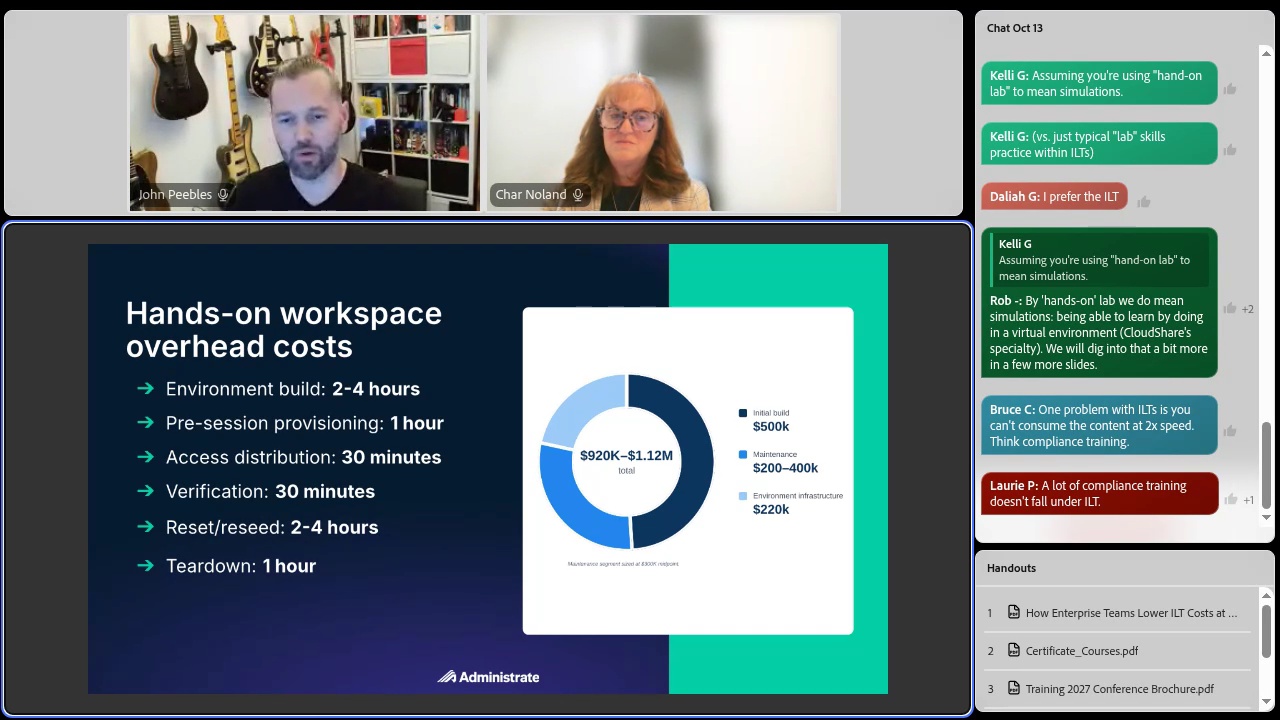
Do we have licensing issues that we need to think about on machines? And then how do we repeat it again next week when we start all over at the beginning? It just... It starts to balloon and as you start to manage the numbers, it just becomes harder and harder to do some of these tasks manually over and over again. And like you guys did, we put that, you can go to the next slide, we put that that down in hours for just a simple class, you know, whether you're building an environment, two to four hours to maybe reset it from where it was last week and receive the data. Maybe getting it spun up ahead of the class so that it's ready to go when the students walk in. Verifying that everybody has a username and password.
I know there's not an instructor around that hasn't had to take, you know, ten minutes at the start of the class to get that that one person that doesn't seem to have their email with their password set and ready to go. And then we frequently meet people that are are tearing things down and resetting on the weekends because the class starts over again on Monday. So you take numbers like these and you multiply them out for even a few classes a month, and you're looking at maintenance of of, you know, a lot of significant money. And the other thing that you mentioned in your survey that I think was incredibly real was the notion of the opportunity cost. Do you really want your high high end IT professionals stopping to go help a training class get back online because they didn't have the right network, you know, picked for their class?
And do you really want those same people, your your expert trainers, do you really want them having to go chase down usernames and passwords? What are you missing out of that those people could be doing because they're they're getting set up and and taking down labs for class? Yeah. One one of the stats that has always stuck with me and first time I came across is about, I don't know, fourteen, fifteen years ago, right right when we got started at Administrate. And what it was is a survey over years and years worth of training data. I think it was... Training Industry was the group that put it together. And they basically came away that the number one factor influencing a student's perception of the quality of training that they received was whether the administrative experience was smooth.
Right? Whether the booking and getting their password and clicking the link and it works and they show up and everything's... If the... If all of the kind of ceremony around getting, into that class, learning, you know, and then and then having the the class get get finished and so forth. If that was all smooth, they, all things being equal, rated that class and that training as a much higher quality, than than anything else. And so, you know, we love that stat because this is kind of the problem we're trying to solve, but, you know, it it it permeates into everything. And, you know, my my girlfriend is genuinely one of the smartest people I've ever, you know, been around. I mean, just an incredible whiz at spreadsheets and formulas and all this stuff, but she cannot log in to any computer anywhere to save her life.
Right? It's just username, password, and and so that friction that that you have. And a lot of times, folks kinda forget when, you know, elearning is a lot of the bulk of maybe what we focus on on a day to day basis. The pressure that's involved when you've got 20, 30, a 100 students showing up at exactly the same time ready to go with a teacher or a, you know, series of instructors standing by to to to be there. It's a lot of pressure, and it all happens at once. And there's nothing you can do to really to, like, spread it out. So, this is a great segue to this this, kind of theme here, which is, you know, nailing it before we scale it. It's a bit cheesy, but it's it's absolutely true. And, you know, this is one of the questions we have for you is how many ILT or VILT trainings are you doing every year?
And kind of a corollary to this is while we're answering this, and the the choices should be popping up in just a second, is even even if you're just doing kind of long running classes, if there's a lot of sessions involved in those classes, that can really amp up the complexity because we see a lot of this with with our mutual customers with CloudShare is, you know, you might do a couple hours of instructor led training, and then you might have four, five, six different separate labs that you have to go through and complete. You know? And that's six environments you have to set up and tear down if you're the administrator and and six different logins that you need to get and all those type of thing. And so, you know, that complexity again just can really explode out if you're not careful. It's true.
Even, like, even something like being able to pick the language that you wanna see in the environment and making that a simple process can make a world of difference to a student. Yeah. Or how about this one? We were we were going on-site with a prospect in France, and they were like, oh, can you please just use our computer? Because it's all hooked up to this AV, and they had some people dialed in, and they were there. And so I started I started to go to log in right after kind of making fun of my girlfriend is... And, like, not working. Right? And who knew? I mean, a lot of people a lot of people in France know this, but the France has a different keyboard than It's true. We we use in in The States. Right? And so I was, like, sitting there literally trying to find where the keys were or whatever. You can solve all of that with CloudShare.
Right? And you can set up your key bindings, and you don't have to worry about it. And it's just really nice to not have those problems. Absolutely. So... Okay. So looks like most people are less than a 100 ILT or VILT trainings each year. About a third are doing between a hundred and three hundred, so that's, you know, probably about one to two per business day. And then there's a few of you folks, and I really hope you're an Administrate customer and a CloudShare customer today. If not, we should talk, are doing between three hundred and five hundred because that's getting to be quite a lot of events. But we have we have customers that are doing thousands and thousands of these events every year, and it's all over the world. It's not just in one location usually, but that's the type of scale that that we're talking about.
So, really... And you'll know this if you've ever lived this. Those of us that, you know, have worked in the industry for a long time understand that errors compound at scale. Right? And errors could be anything from a typo to a, you know, a calendar conflict or you booked the wrong instructor on the wrong session, whatever it is, you forget to send an email or you send the wrong... We've all gotten those "Hi first name" emails. Know, these types of things can really start to explode out at scale. And this is kind of one of those ways that we think about this, I think. Somebody said that Halloween's coming up, so that's why we're talking about Frankenstein. But, you know, it it is kind of appropriate. Right?
We see a lot of Frankensteins out there, which are these kind of collections of a spreadsheet here. Or if you're really sophisticated, sometimes it's an Airtable glued into a Google spreadsheet that is glued into maybe Eventbrite or some sort of, WordPress plugin for for getting those courses out there where people can buy them and register. You know, calendars will work into this somewhat. You know, everybody's got meeting room calendars, but they're often not connected or you can't see them in one consolidated view or maybe, you know, The US system is different from the European system, whatever it is. Everything around communications, we see a lot of customers come online with Administrate. And previously, they were struggling to send out one or two emails about how to get registered or where to go and so forth because it was just difficult to do that.
And, again, more communication translates into higher quality perception by learners, and it's a way to improve your product, and so on. So these are some of the things that we think about when we're thinking about the challenges that can happen. And so we wanna really talk maybe about Ping Identity, which is a mutual customer of CloudShare and Administrate. They started life with us, as they weren't Ping Identity. They were a company called ForgeRock. And this is one of my all time favorite stories where is... They actually came to us as a Series A startup. They, at the time, I think, were 20 or 30 people. And what they did was they were an identity management single sign on provider before we all had probably heard of that.
It was a bunch of ex Sun folks. They took some open source software that Sun had spun out before it kinda met its demise, and they said, we think that this identity management thing will be important. We think that we can build a company around this open source core product. And, they came to us and said, look. We know we're gonna scale. We're gonna scale quickly, and they wanted to nail it before they scaled it. And they said, we need a system to help us manage this complex classroom training of how to get up and running with this complex open source, very, very important, high secure... Highly secure piece of software. And they said, oh, and by the way... So we we signed the contract with them, and they said, oh, and, by the way, you've gotta get integrated with CloudShare ASAP.
We were like, what's CloudShare? Right? And so, you know, that's when we met the team at CloudShare. And, really, you know, installing the software was not not easy, but it needed... They needed to get up and running. They needed their students to have hands on scenario based virtual lab environments that they could practice in. And... Yeah. What what what am I missing here, Char? Well, I think, you know, we find this so often with technology providers, but we also find it in, you know, health care and financial services. When customers are learning training, it's not just one simple application like the ones we download on our phone in two minutes and we teach ourselves. A lot of these companies really, in order to learn their application, they have to interact with other types of application, whether it's to stop a cybersecurity threat or make sure someone's identity is really who they are for the HR system and the ERP system and all the other companies' systems.
So having a virtual lab and having to set up that complex of a training environment is tough because a lot of times it's not just one application, that one thing you download on your phone. It's really complex stuff that you have to have a customer or a prospect practice on in order to get good at it. So setting up that type of environment, you know, it it takes an IT professional. It takes somebody who's who's a fairly high priced resource who needs to come in and design that and get it set up and then make it repeatable. So like you said, you know, setting up virtual labs, but coordinating that with the people that were coming to make it seamless, who's signing up, what day are they taking it, is is a really big deal.
Yeah. And so some of the ForgeRock classes are really interesting because this is single sign on software. Right? And if it doesn't work or if it's misconfigured, your entire company, maybe all of your partners, maybe all of your customers, maybe all of them cannot literally log in. Right? And so it's it's high stakes. You know, the CEO of your company will notice if he can't log in or she can't log in. Right? And and you wanna you wanna get it configured correctly, but it's very complicated. And so when we were looking at classes that ForgeRock was offering, they did, kind of a... An interesting model where for years, they would, give away some of the training, they would sell some of the training, and then they would sell certification. Right? And so you could get... Become a ForgeRock certified engineer.
But that meant that a lot of the modules of these classes that could run for weeks or months would be... They needed to set up a broken scenario and have the student come in and be able to diagnose it and fix it. And so if you think about setting this complex software up and then making sure that it's broken in the right way so that somebody can come in and fix it, These are the scenarios or recipes that they would basically load up on CloudShare. They would link to Administrate courses. And then when they went to schedule the class, Administrate would know that for this session, this particular recipe or I can't remember exactly what you call the the the recipe in in CloudShare. The blueprint? Blueprint. That's right. That this blueprint would be invoked, and and it works so well.
So it was really interesting to kinda kinda watch that unfold. And on top of that, Ping was, like we said, giving away some of the training, but they were also selling their training, and they sold millions of dollars of it. And, one of the things that they would do is, you know, they'd sell sell you a few million dollars for your massive, huge, single sign on solution. One of my favorite facts is that here in The UK, all of the open banking transactions that flow through, that UK infrastructure, are basically authenticated by ForgeRock, now Ping Identity, software. So when when they started to scale, they had a whole bunch of problems as well. Right? Because they were a growing company.
They went from a Series A startup to Series B, one of the fastest growing tech companies in the world, all the way to going public. And then eventually, a couple years ago, they went private and merged with Ping, and Ping Identity is now the name that the the kind of merge company has taken on board. But it's still the same training team, and they're still using Administrate and CloudShare. But one of the things that they they had as a challenge as they were scaling and before we had everything kind of automated for them like we do today, they were spending tons and tons of time on administrative work, and this is with Administrate, but the... Without having the the the hookup with CloudShare. Their completion rates were down.
Know, they were growing quickly, and they had all these problems. Right? And they really, really wanted just a nice, modern, seamless experience. And so what happened is we all got the work. Right? CloudShare, us, a couple other vendors, you know, the team over at ForgeRock, rolled up our sleeves, and we said, how are we gonna build out really a joint solution in a in a real, you know, in in a spirit partnership. And we had to build features onto our platform, you know, CloudShare to do stuff on theirs. You know, it was it was it was all hands to the pump. But, ultimately, we came up with an integration that works really well. And I I don't know, Char, if you wanna maybe describe a little bit about how this works, or I can walk us through it as well.
But, yeah, there was... It was... It was really interesting, fun time to to get out there and innovate. And the team won some awards based on what they what they did. It's true. And and there were some some amazing statistics behind it. I'll let you go into the functional specifics, but just seeing things like being able to handle three times the demand without having to increase the support staff and letting IT go back to their day jobs because they reduced, you know, this 20% of the time they were spending building labs for training. All of those things I think are are what... As two companies, we were we were so proud of. But it really was letting them scale huge amounts without adding staff in the support arena. Yeah. Absolutely.
And so the way this works is CloudShare has its blueprints, and we have what we call our course templates. And, basically, they're both ways to describe things that need to happen in order for the ILT or VILT session to to occur, and we link them together. And, what that means is that when somebody says that they want to schedule a, you know, Ping Identity Management 101, course, there will be various CloudShare blueprints linked to that within the course template in Administrate. You schedule the event, and boom. It it goes, and CloudShare learns about it. And then I think it's just a a few minutes before the class is supposed to start. Those environments start spinning up for those students one by one. And and there's there's ways you can configure it and so forth, but it's, you know, really, really cool, and we'd like to geek out over it.
But, yeah, the the interesting thing, back to your point, Char, was, as ForgeRock exploded and went all the way to, you know, a couple thousand employees, I think, when they went public, they, the training team stayed exactly the same size throughout the entire journey. It was something like four or five people the entire way, and they had a engineer for about a year or so while we were really working on knitting together a couple other systems with Administrate and CloudShare and so forth. And then it was kinda like, oh, the engineer's gone. And it's like, what what happened? It's like, oh, nothing. We just don't need him anymore. Right? He's going back to do other engineering stuff, back to that opportunity cost, you know, kind of, idea. So, yeah, it's a it's a fantastic, story. And here's just a few metrics that really kind of set the scene. There's...
You can hear it from Leonie, who's now the the champion over there at Ping Identity. You can hear it from her directly out on our website where she talks about how to get all this stuff hooked up and and save a lot of time. This is Leonie. She is super smart and has talked a lot about this idea of how do you scale training and how do you do it without ramping up your headcount dramatically? And, you know, I... If if she were here today, I would say one of the things that has been really interesting is merger is never a super comfortable time for everybody when two companies are kinda getting smushed together.
And I think that it was really interesting seeing how... Because Leonie had invested over the years and, before... Her predecessor before was a guy named Kevin Streater. Because they worked together to really invest in this kind of foundation, that could scale, when it came time to merge, they were really kind of at the point where they were sitting pretty. Right? They they were not a huge budget line item, and they'd... There wasn't a lot of efficiency to be gained, and they were running really lean and mean, and and it was just a... It's a wonderful story for that team. They kind of rode out rode out that chaos, and, it was much... It it was just nicer than it probably, could have been if they had this huge team and and were worried about, you know, all the things that you worry about when it comes to to to a merger like that.
Okay. So let's talk a little bit about budgets. Understanding administrative debt, the admin and workspace overhead, looking at your ugly Frankenstein's monster, and a little bit about AI, which, of course, we had to mention. So thoughts on this, Char? Yep. I I think the first step, you know, and the first step of understanding your your debt, it's understanding the true cost of people's time. Because a lot of times people think, oh, if I'm getting a bill from a vendor, then that's my cost of of this, of setting up rooms, or that's my cost of virtual labs. But if you still got a lot of people running around doing administrative functions over and over again, you've got administrative debt.
And I think it's hard... I I think sometimes it's hard for people to put a price tag on it, but it's a big cost and people have to realize that. Same is true with looking at, you know, again, the Frankenstein's monster. How many pieces of, you know, technology or software are you are you paying to get one class done? Are you paying a provider like a Zoom to get the message out? Are you provide... Paying for licenses on machines or laptops? Are you paying for cost to to get a teacher flown into a location? Look at all of the different components. It's not just the cost of third party vendors that really cost companies a lot when it comes to setting up and running a training class.
Yeah. Totally. I think number two is always interesting for us as well because when we start kinda going through the the sales process or as I like to call it, the problem solving process, right, A lot of folks have never really sat down and kind of thought through, okay. Here's the customer journey or the the learner journey. And like you were saying, what are all the different systems that they touch and and what, you know, mapping it out. And a lot of times when we start doing ROI analysis and, you know, okay, how much time you're spending here or there, people are really surprised at what that exercise, you know, shows, that the time is far greater than they would have thought. And, you know, this... The interruptive nature of classroom training, you know, ILT and VILT, because that class is starting in seven minutes.
You have to drop what you're doing and get whatever it is that needs to be done. And there's no real respite from that kind of... And we put together a perfect plan last week, and it's Monday morning, and now somebody's sick and the classroom is no longer available, and we gotta deal with it. And and it's a very, interruptive way of working. It can be, extremely difficult when you multiply that out by different locations and countries and teams and so forth, and the business will depend on it. I think bullet point number four is interesting to me, not because everything has to, you know, lead back to AI, but, you know, there's been some really fun and interesting applications of AI that we've been able to build into the Administrate platform in conjunction with some of our partners.
And what that has meant is that all of us are under budgetary pressure, and we've seen budgets get under pressure at various times over the last decade or so. But we've seen kind of a renewed source of unlock, whereas you may not have a lot of budget to spend on streamlining your ILT or getting a virtual lab provider in, but you may have AI budget that the organization is very interested in spending and deploying. And so if you can find an AI powered solution like Administrate and Administrate plus CloudShare, then all of a sudden, that could be an unlock for you if you're thinking about how do I pay for this or where can I get money for this? So that's that's just a thought that I think is, interesting that we've seen kind of developing, over time.
Yeah. And especially too when you think about, you know, whether it's building environments or checking students' work. Again, those are things that you have to do over and over again. And there is AI powered functionality to do that in a virtual lab provider. So give that student not only the immediate feedback that they they need and they want, but have them do those repetitive tasks over and over again. Do that with AI. It's possible. It's there today. Yeah. Absolutely. Okay. So I think we've got about seven or eight minutes left. This is a QR code for a guide that will kind of talk about all this stuff and and hopefully pull it together for you to download. But I think we're gonna open it up to some questions from any of you out there, and thanks for listening.
So gonna scan through and see what questions we have. And, John, I've been collecting some questions for you, and we have some for you and and for Char. But Kelli asked a question back when you were talking about Ping. She was saying, what what about the leadership development type sims? Not software equipment, but decision making and strategic planning and so forth. Well, can you talk about that a little bit? Yeah. So I... You know, we see we see all types of training running through Administrate, and simulation is one of those things that I find very cool. Some of our customers have simulators from everything from, like, Maersk in Denmark to, you know, how to drive a crane, to some of the more soft skill type things.
You know, I'm not an expert in the ins and outs of various simulation platforms, but I do know that we we link up with them quite a lot, and they're very important for customers. They tend to be very industry specific as well. So I don't know, Char, if you got anything to add. Yeah. Mostly, I I mean, obviously, my company focuses on, you know, more of the virtual lab and the hands on lab. But certainly, if there's a place where a simulation makes sense and it could be integrated either with a CloudShare for for the live session or an LMS, certainly, that's something that's possible and and might be valuable in some situations. Okay. So what are some strategies that you've recommended in the past to to lower ILT cost?
I know you talked about this a little bit, but maybe expand on it. I think for us, the biggest thing that we kind of always find ourselves talking about is automation. Right? A lot of this ILT, VILT stuff can be automated. Anything that, like, was saying, you're doing over and over again, there's probably a way to automate that. And I think we've just... You know, the job of ILT, VILT is not to do the administrative work. It's important, and it's required, but that's not really the job. The job is to get in the classroom and affect outcomes. Right? And so if we can kind of take our minds away from the paperwork and the filing and the scheduling and all that, that's not actually the job that we're supposed to be doing, then it's like, okay.
Well, let's have software do those jobs. And software can do huge percentage of those jobs. We we talk about it all the time. We can automate 90% of your classroom in ILT and VILT training in ninety days. And nobody really believes us about this whenever we say this, but customer after customer is like, you guys are right. It's 90%. It's 89%, you know, 92%, whatever. And we have the data now over a decade to to back it up. So automation is really the the number one thing for us that we think about. Great. What usually breaks first when training programs try to scale? Think I think that was a target to to Char there. Yeah. What usually breaks first?
I think a lot of people think their software is going to work perfectly every time in every environment. And so I I think what breaks first is is usually people can't log in one day or they all log in and they're going as slow as could be. And they find out they just didn't have the resources to really run the the event or the class that they thought they could. Yeah. That makes sense. Okay. Well, how do you decide, John, where it's appropriate to use AI? Oh, man. This is entirely different. We could do a whole hour or discussion discussion on this. I have a strong opinion, and that is we at Administrate, our strategy is really around applying AI within a deterministic framework.
Meaning, AI is very good at a whole bunch of things, but we don't want to just say, oh, you know, throw Claude at a spreadsheet and and ask it to make a schedule and get an outcome. Instead, we try to apply LLMs in particular within very constrained environments where when they come up with a scheduling recommendation, for example, it's because we validated that it is correct, it is possible, and, you know, it it is something that will not be hallucinated. So for us, really, we we think about applying AI, kind of this agentic, you know, shell and a deterministic core. And there's a whole bunch of stuff on our website, if that was all kind of confusing or whatever that you can read more about that.
Okay. And one more for Char here. Char, have you seen companies use labs to increase their training revenue successfully? Absolutely. Absolutely. If if I'm going to offer a class where you click through a bunch of PowerPoints and and you can skip to the end, I probably can't charge too much for that type of training. If I bring in a skilled skilled instructor who can bring knowledge and stories and best practices and give you a hands on experience, you can absolutely charge for that kind of a quality experience. Great. Thank you. Kelli had a a question. I think this deserves more of a conversation. And, John, I wonder if you can talk to her about that or maybe have somebody else in your organization that could have a have a longer offline about it.
But she said they've been looking for a vendor to provide these business planning simulations as a component to their ILT sessions, but they've been unsuccessful. Do you have somebody that can have a conversation with Kelli about that? Yeah. Absolutely. Like like I said, I don't know off the top of my head. I'm not kind of up to speed necessarily in the simulation space, but, you know, we... We're gonna be at DevLearn. We go to trade shows all the time, and we try to learn about what's out there. And so we've got a number of industry experts on our on our team. And, yeah, they'll... Their their their title is sales, but, really, you know, we'll we'll be real quick to to say, hey. This is what we know about the market, and go call these folks over here because we try to be helpful even when folks aren't necessarily looking for a solution like Administrate.
So, yeah, definitely get in touch with us. We can probably point you in the right direction. And if not, we'll be the first to tell you. Okay. So, Kelli, we can huddle up a little bit later on and and and establish some lines of communication there. We are at the end of our time and and glad to, have had this time, with, CloudShare and with, excuse me, with Administrate. So thank you to Administrate for making this session possible and to all of you for coming today. I hope you were able to download the handout. If not, if you're watching the recording, they're available to you in the recording. And if anybody's blocked or anything from... We appreciate those of you who who listed your takeaways over in the left hand corner.
But I think there are probably more folks here who could give John and Charlene to... A hint as to what resonated with you. So please, they welcome your comments in the bottom left hand corner. What are your takeaways there? And thank you everybody for coming. If you'd like to thank John and Charlene for more, just put it in the main chat there. And for those of you here from the British Virgin Islands, if you are looking for a certificate, you can stick around and talk to me, and I'll help direct you to that. I know you folks are, are are eager to, to acquire your certificate. Thank you, everybody, for coming. Look forward to seeing you again next time. And, John, that hour that you wanted to talk about, well, yeah, maybe we can arrange that. Right?
Absolutely. Sound great. Thank you for calling that. There you go. Alright, everybody. Thanks.

